GAME / 2026
TAMAGO.exe
What will you keep, and where will you put it? Build meals from five slot results and clear nine gates in a cooking roguelike. As your egg becomes a dragon, the whole world evolves from 8-bit to 2D and dimensional art.
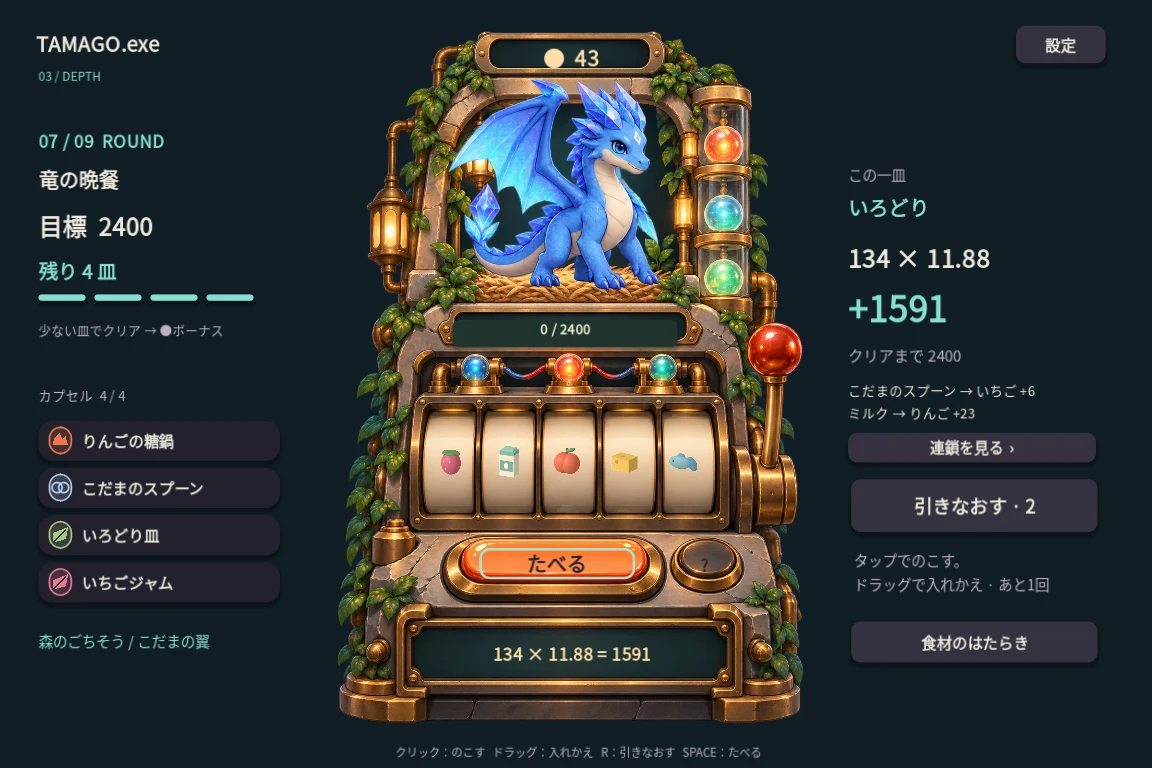
TAMAGO.exe / PLAY v4
Your next plate could change everything.
Play the Japanese-language browser version. Keep foods, change their positions, and build trigger combinations. A computer screen and mouse are recommended.
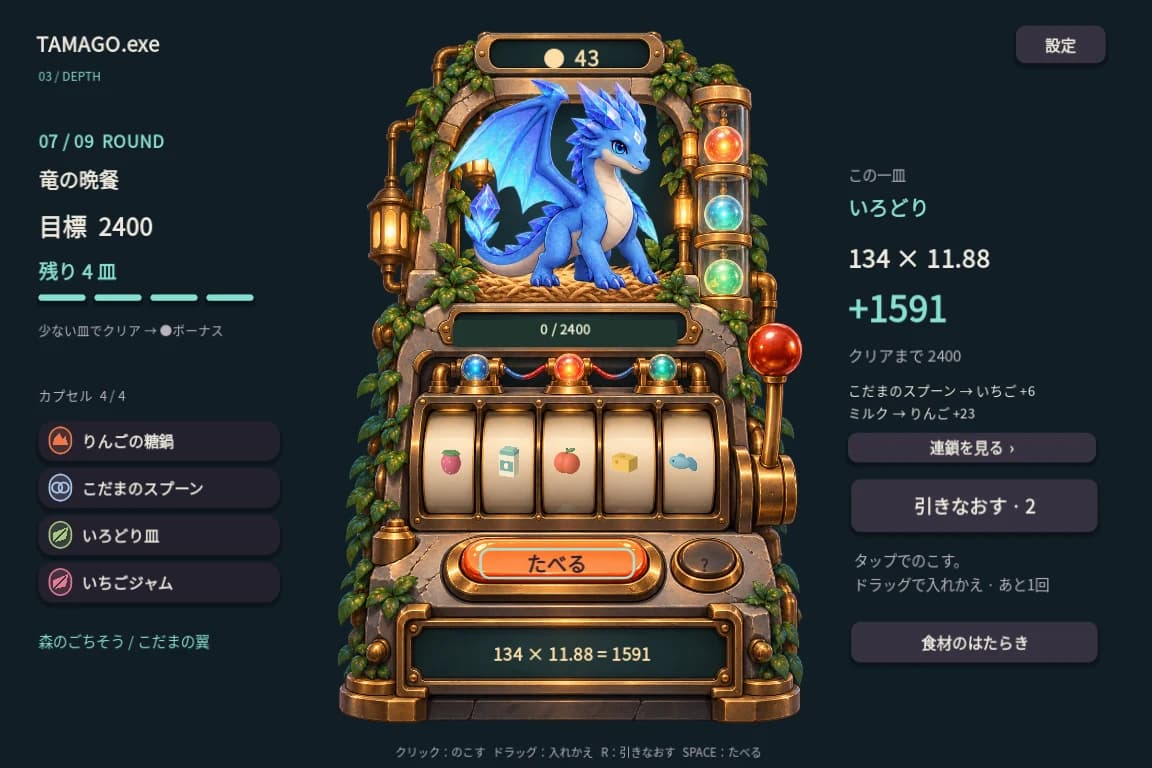
The game loads only after launch. On smaller screens, open it in a separate tab.
Three decisions
- 01
Keep
Click foods to hold them. Share two rerolls across each gate, then press Eat to commit the plate.
- 02
Swap
Drag two foods to swap them once per plate. A milk or jam neighbor changes which food triggers again.
- 03
Build
Reach the target within four plates. Rebuild a ten-food bag and four capsule slots in the shop, aiming to clear all nine gates.
GAME DESIGN / 日本語 PDF
The rules, and the thinking behind them.
The Japanese design document covers the concept, core loop, food and capsule combinations, and three visual eras.
Download the design document (PDF, Japanese)MAKING & CREDITS
Making the game
Concept, game design, and direction by Kashin Ou (王家進), with AI-assisted implementation and AI-generated dragon and cabinet art. The dimensional era combines an animated dragon image with 3D food models. All screenshots shown here were captured from the game.
- 01Four plates · two rerolls · one swap per plate
- 02Six foods × twelve capsules
- 03Nine gates from 8-bit to 2D to dimensional art
Problem & goal
Since the first version, I have regularly invited players to try the game and used their feedback to guide revisions. Their playtests surfaced text overload, uncertainty about the next action, and repetitive interactions. Those findings shaped changes to the amount of explanation, the interface flow, and the choices involved in preparing a meal.
Technical challenge
The challenge was giving players a reason to keep or reposition each of five random ingredients without piling on controls. Three visual eras also needed a consistent layout so that evolution would not hide the next action.
Solution
Decisions center on four plates per gate, two shared rerolls, and one positional swap per plate. Six foods grow nutrition, replay neighbors, add multipliers, or earn coins. A random shop reshapes a ten-item bag and four capsule slots, with a nutrition-times-multiplier preview before every meal. Evolutions after gates three and six add a new build choice.
Result & learning
Repeated revisions informed by real player feedback have led to a Japanese-language game spanning nine gates and three acts, with six foods, twelve capsules, and two evolution choices. Failing a gate ends the run; only discoveries carry over, inviting a different build. Alongside ongoing player playtests, automated checks and simulations cover scoring, random-state restoration, shops, and progression.